
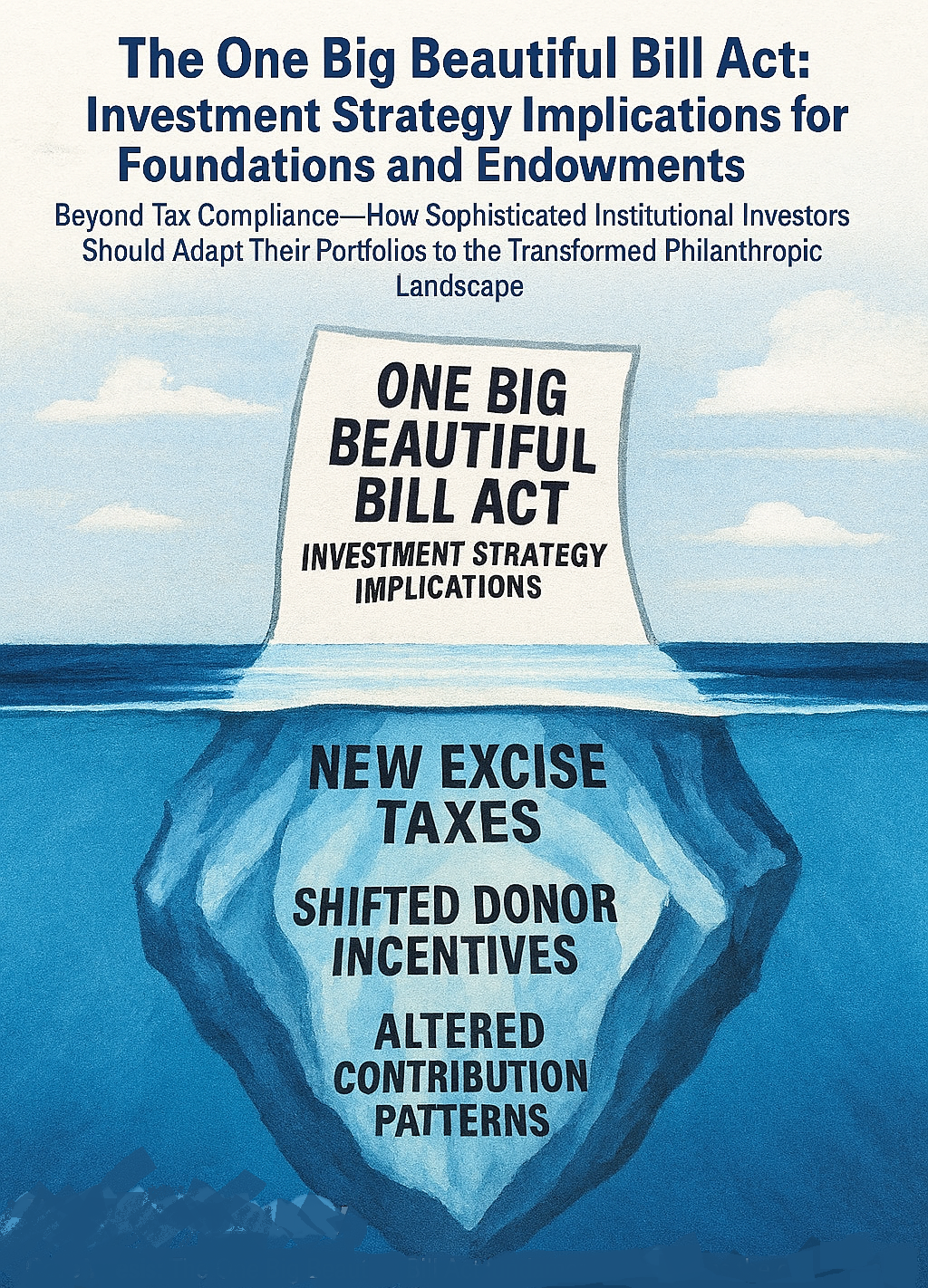
Executive Summary: The One Big Beautiful Bill Act (OBBBA), signed into law in April 2025, represents a potentially significant restructuring of tax incentives affecting philanthropic organizations. For investment committees and foundation boards managing $10 million or more in assets, this legislation may introduce material changes to donor behavior, institutional costs, and service demand patterns that merit sophisticated financial analysis and strategic planning.
This article examines OBBBA's provisions through the lens of investment strategy, portfolio construction, and fiduciary decision-making for institutional investors in the philanthropic sector.
Key Provisions at a Glance
| Provision | Effective Date | Primary Implication | Investment Committee Considerations |
|---|---|---|---|
| Universal Charitable Deduction ($1K/$2K) | Jan 1, 2026 | May broaden donor base | Model contribution patterns for smaller donors |
| 0.5% AGI Floor for Itemizers | Jan 1, 2026 | May reduce mid-level giving | Potential volatility in $5K-$25K donor segment |
| Charitable Deduction Value Cap (35% vs. 37%) | Jan 1, 2026 | May reduce high-dollar contributions | Q4 2025 surge likely; 2026-27 adjustment possible |
| Corporate 1% Giving Floor | Jan 1, 2026 | May restructure corporate giving | Potential concentration of fewer, larger gifts |
| Executive Compensation Excise Tax | Jan 1, 2026 | 21% tax on expanded covered remuneration | May create portfolio drag for certain organizations |
| Tiered University Endowment Tax | Jan 1, 2026 | Tax on university net investment income 1.4% ($500K-$750K/student) 4% ($750K-$2M/student) 8% ($2M+/student) Illustrative — see statute for calculation rules |
Fundamental spending policy recalibration needed |
| $15M/$30M Estate Exemption | Jan 1, 2026 | May reduce bequest motivation | Emphasize impact over tax benefits |
| $1,700 Scholarship Credit | Jan 1, 2027 | May redirect dollars to education | Competitive pressure for non-education orgs |
I. The Changing Donor Landscape: Modeling 2026-2028 Contribution Scenarios
Understanding how tax changes may reshape giving patterns is essential for cash flow modeling and spending policy decisions.
According to Giving USA's 2025 Annual Report on Philanthropy, charitable giving in the United States in 2024 totaled $593 billion:
- Individuals: $392 billion (66%)
- Foundations: $110 billion (19%)
- Bequests: $46 billion (8%)
- Corporations: $44 billion (7%)
Why this matters: The OBBBA's provisions affect each funding source differently. Individual giving—which comprises two-thirds of all contributions—faces the most complex changes through the combination of universal deductions, AGI floors, and bracket caps.
Provisions That May Increase Giving
Universal Charitable Deduction
- May create tax incentives for approximately 90% of taxpayers who take the standard deduction
- Up to $1,000 (single) or $2,000 (joint) starting January 1, 2026
- Excludes donor-advised funds, supporting organizations, and private foundations
- According to the Joint Committee on Taxation (JCX-29-25), this provision is estimated to generate approximately $74 billion in additional contributions over 10 years, though actual results may vary based on donor behavior and economic conditions. (See JCT revenue estimates for detailed projections)
The universal deduction's exclusion of donor-advised funds may create a subtle but potentially significant competitive shift:
For small-dollar donors ($1K-$2K): Direct giving to public charities now may provide immediate tax benefit, potentially reducing DAF contributions in this segment.
For high-income donors: DAFs may remain valuable for bunching strategies, especially given the new 0.5% AGI floor. A donor can make a large DAF contribution in a single year to potentially maximize deductions, then grant from the DAF over multiple years.
Strategic positioning considerations for foundations: Organizations may wish to emphasize the advantages of direct support—immediate mission impact, donor relationship depth, and the new universal deduction benefit—while acknowledging DAFs' continued relevance for sophisticated multi-year giving strategies. The key may be demonstrating tangible impact that motivates giving beyond tax optimization alone.
Preserved and Enhanced Incentives
- Permanent extension of 60% AGI limit for cash contributions
- $1,700 scholarship tax credit (effective 2027) for educational giving
State and Local Tax (SALT) Deduction Increase
- SALT cap increased from $10,000 to $40,000 for 2025
- Annual 1% increase through 2029, then reverts to $10,000 in 2030
- Phase-out for taxpayers with modified AGI above $500,000 ($250K for married filing separately)
Potential Indirect Charitable Giving Impact:
The expanded SALT deduction may have competing effects on charitable contributions:
- Potential positive effect: More taxpayers may find it worthwhile to itemize deductions, potentially making charitable contributions tax-deductible for a broader base
- Potential negative effect: Higher SALT deductions could reduce the incremental value of charitable contributions in pushing taxpayers over the standard deduction threshold
- Analyst estimates: Some analysts (e.g., Tax Foundation) estimate that OBBBA could materially change itemization patterns—estimates vary by model; monitor actual 2026 tax returns for definitive data. (See Tax Foundation analysis for modeling assumptions)
- Net effect uncertain: Investment committees may wish to monitor actual itemization patterns through 2026-2027 tax seasons to better understand regional and donor-specific impacts
Provisions That May Decrease Giving
0.5% AGI Floor for Itemizers
- Couples with $300,000 AGI must exceed $1,500 in contributions before receiving tax benefit
- May disproportionately affect $5,000-$25,000 annual donors
- Potential impact: This segment often forms the backbone of foundation donor bases
Charitable Deduction Value Cap for High-Income Donors
- Limits the value of itemized charitable deductions for top-bracket taxpayers to 35% of contribution value (vs. 37% marginal benefit currently)
- Applies to taxpayers in the 37% tax bracket starting January 1, 2026
- Reduces benefit from $370 to $350 per $1,000 donated (5.4% reduction)
- Independent Sector research: High-income donors demonstrate significant tax-sensitivity in giving decisions
- Historical context: Lilly Family School of Philanthropy studies confirm that marginal tax rate changes may affect donation timing and amounts among top earners
- According to the Joint Committee on Taxation (JCX-29-25), the combination of the universal deduction and limits on itemized deductions is estimated to yield net revenue changes of approximately $64.9 billion over 10 years. (See JCT table for line-item detail)
Planning Response:
- Accelerate 2025 gifts: Donors considering major contributions may wish to complete them before December 31, 2025
- Multi-year pledges: Consider front-loading payment schedules to potentially capture 37% benefit
- Bunching strategies: Consolidate multiple years of giving into 2025 to potentially maximize current deduction rate
Corporate Giving Floor
- New 1% floor: corporations may deduct only contributions exceeding 1% of taxable income, subject to corporate tax posture, NOL availability, and deductible income definitions under Treasury guidance
- Existing 10% ceiling remains (deductions generally limited to contributions between 1% and 10%)
- Complex carryforward rules: Contributions below 1% floor can only be carried forward if corporation exceeds 10% ceiling
- JCT revenue estimate: Projected $16.6 billion over 10 years (see JCX-29-25)
- Independent Sector research: Estimates average annual reduction in corporate giving of approximately $4.5 billion
Potential Investment Committee Implications:
This provision may create a "deductibility band" from 1-10% of taxable income, potentially changing corporate giving patterns:
- Possible consolidation pressure: Corporations with modest profitability may eliminate small charitable contributions entirely if they cannot reach the 1% threshold
- Strategic timing considerations: Profitable corporations may bunch multi-year commitments into single tax years to potentially maximize benefit
- Relationship shifts: Fewer corporate donors, but those that give may give more strategically to exceed thresholds
- Planning horizon: Foundations relying heavily on corporate sponsorships should consider modeling various revenue scenarios for 2026-2028
This example is for illustrative purposes only and does not consider AMT, state tax, or other factors. Corporate tax situations vary considerably; consult with tax advisors regarding specific circumstances.
Corporation with $5M taxable income:
- 1% threshold = $50,000
- Gifts under $50K may receive no tax benefit
- Only the portion between $50K and $500K (10% ceiling) may be deductible
Before OBBBA: A $25K gift could have provided approximately $5,250 tax benefit (at 21% corporate rate)
After OBBBA: Same $25K gift may provide $0 tax benefit if below threshold
Potential result: Corporations may eliminate sub-threshold giving or consolidate multiple years of support into single larger contributions that exceed the 1% floor. However, actual corporate giving decisions depend on numerous factors beyond tax considerations.
Estate Tax Exemption Increase
- Permanent increase to $15M (single) or $30M (married) effective January 1, 2026 (see P.L. 119-21, Title IV)
- Indexed for inflation: Exemption amounts may increase annually, starting with 2027 adjustments
- Estimated less than 0.1% of estates may face federal estate tax
- Strategic considerations: Donor communications may need to shift from tax avoidance to impact and legacy messaging
- Lifetime giving considerations: For most donors, lifetime charitable gifts may now provide more tax benefit than estate bequests
Potential Bequest Planning Considerations:
With estate tax motivation potentially eliminated for all but the wealthiest 0.1%, foundations may wish to consider reframing planned giving conversations:
- From: "Reduce your estate tax burden"
- To: "Create lasting impact" and "Build your philanthropic legacy"
- Opportunity to highlight: IRA and retirement account charitable beneficiary designations, which may help avoid income tax on distributions (consult with tax advisors)
- Donor education consideration: Many donors may not realize estate tax no longer applies to them; proactive communication could help prevent lost bequest opportunities
This simplified example does not account for AMT, state taxes, AGI limitations, or other factors. Individual circumstances vary; consult tax advisors.
Married couple, $500,000 AGI, $20,000 charitable contribution:
2025 (Last year under current law):
- Tax bracket: 37%
- Deduction value: $7,400 (37% of $20,000)
- No AGI floor to overcome
2026 and beyond (Under OBBBA):
- Tax bracket: Still likely 37%
- Deduction cap: 35%
- 0.5% AGI floor: Must exceed $2,500 to receive benefit
- Deductible amount: $17,500 ($20,000 - $2,500 floor)
- Deduction value: $6,125 (35% of $17,500)
- Net difference: $1,275 less benefit (17% reduction)
Strategic response: Accelerate 2025 giving or consider bunching strategies to maximize value of contributions under new rules.
II. Direct Institutional Costs: Excise Taxes That May Function as Portfolio Drags
Two OBBBA provisions may directly increase costs for certain institutional nonprofits, potentially reducing net investment returns.
Executive Compensation Excise Tax Expansion
Before OBBBA:
- 21% excise tax on compensation over $1M for top 5 employees only
After OBBBA (effective January 1, 2026):
The Act expands the 21% excise tax under IRC §4960 by broadening which payments and payees are covered. In practice this means the excise tax can apply to remuneration and certain parachute payments in excess of $1,000,000 for current employees and, in specified circumstances, certain former employees. The statute and implementing guidance also establish specific definitional rules and exclusions (for example, certain medical practitioner compensation). Consult counsel for an exposure analysis. (See P.L. 119-21 text and IRS implementing guidance; practitioner commentary available from CLA, Warren Averett, and others)
⚠️ Consideration: Severance Exposure
The expansion to certain parachute payments means that nonprofit executives negotiating departure packages may need to account for an additional 21% excise tax on qualifying severance payments. This could potentially affect:
- Executive transition planning
- Board discussions of severance agreements
- Total cost calculations for leadership changes
Suggested action: Organizations may wish to review all employment agreements and severance provisions with legal and tax counsel to assess potential exposure.
Who This May Affect:
- Large healthcare systems
- Universities
- Foundations with highly compensated investment staff or executives
Hypothetical example for illustrative purposes only. Actual tax liability depends on specific employee compensation structures, statutory definitions, exclusions, and organizational circumstances.
$100M endowment with compensation potentially triggering excise tax
Estimated additional excise tax liability (amount depends on specific facts)
This could require additional return to maintain net performance
Note: Organizations should consult with tax advisors to calculate their specific exposure, as the application of this provision may depend on various factors including employment dates, compensation structure, timing, and statutory exclusions.
Recommended Action Items:
- Conduct exposure analysis for all employees to identify potential tax liability
- Model after-tax portfolio returns incorporating estimated excise tax costs
- Review compensation structures with legal counsel for potential adjustments that may mitigate tax exposure
Tiered Endowment Tax for Educational Institutions
The statute creates a tiered excise tax on net investment income that applies to applicable educational institutions meeting statutory tests (including student-count and student-adjusted endowment calculations). Rates are tiered (low → mid → high), but applicability depends on statutory thresholds and detailed calculation rules in the law and Treasury guidance. Institutions should run a statutory eligibility test with tax counsel before assuming exposure. (See P.L. 119-21 text; practitioner notes from Troutman, CLA, Warren Averett, and others)
Illustrative Tax Rate Tiers on Net Investment Income:
Illustrative — see statute for actual calculation rules and eligibility criteria
- $500K-$750K per student: 1.4%
- $750K-$2M per student: 4%
- Over $2M per student: 8%
Hypothetical example. Actual tax liability depends on specific endowment structure, student count methodology, net investment income calculations, and statutory definitions. Institutions should consult with tax advisors.
An institution with substantial net investment income potentially facing a mid-level tier:
- Estimated annual excise tax: Depends on specific calculations
- At typical spending rates, this could consume a meaningful portion of annual distribution capacity
- Required return may need to increase to maintain purchasing power
Strategic Considerations:
- Fundamental spending policy recalibration may be required for affected institutions
- After-tax return optimization could become increasingly critical
- May favor tax-exempt municipal bonds and other tax-advantaged structures, depending on specific circumstances
Note: State colleges and universities remain exempt from this provision
Collectively, these provisions may introduce structural return considerations that could merit explicit modeling in both strategic asset allocation and spending policy calibration. Organizations potentially subject to these taxes should consult with qualified tax and investment advisors to evaluate impacts.
III. Federal Program Reductions and Increased Service Demand
Beyond direct tax provisions, OBBBA includes substantial reductions in federal safety net programs. The Congressional Budget Office projects these changes could significantly increase demand for nonprofit services at a time when contribution patterns may become uncertain.
Scale of Federal Program Changes:
Medicaid
- CBO estimate: Reduction of approximately $911 billion over 10 years (source: CBO cost estimate for H.R. 1, Medicaid provisions scoring)
- CBO projection: Millions of Americans projected to lose coverage over the implementation period (see CBO distributional analysis tables)
- Mechanisms: Work requirements, documentation requirements, reduced allowable state provider taxes, cost-sharing to states
- Timeline: Changes phase in over multiple years, with full implementation by 2027
SNAP (Supplemental Nutrition Assistance Program)
- CBO estimate: Reduction of approximately $186 billion over 10 years (source: CBO cost estimate for H.R. 1, SNAP provisions scoring)
- CBO projection: Approximately 3 million people expected to drop out or lose benefits (see CBO distributional analysis tables)
- Mechanisms: Stricter eligibility requirements, enhanced work requirements, time limits, shift of up to 15% of costs to states
Note on data sources: Federal program spending estimates cited here are drawn from CBO's official scoring of H.R. 1 (One Big Beautiful Bill Act). For the most current and detailed breakdowns, consult CBO.gov for published cost estimates and distributional tables. Additional analysis available from Kaiser Family Foundation and other policy research organizations.
Student Loans
- Major overhaul of federal student loan programs
- Elimination of Grad PLUS loans
- Less generous repayment plans
- Forgiveness now after 30 years (previously 20-25 years)
- Total lifetime payment pause limited to 12 months
Potential Direct Implications for Nonprofits
Organizations serving vulnerable populations may face a dual pressure scenario:
As Nonprofit Quarterly notes: "In recent months, nonprofit healthcare organizations have finally begun to recover from the impact of the COVID-19 pandemic, but Medicaid cuts could reverse this progress, as more patients would be unable to pay for their care."
Potential impact: Increased uncompensated care burden at a time when traditional charitable giving may face headwinds from tax changes.
With millions of people projected to potentially lose SNAP benefits, food banks may face demand surges.
Potential impact: Organizations may need to simultaneously increase capacity and potentially reduce reliance on federal commodity programs.
Student loan changes may create increased demand for scholarships, emergency aid, and financial counseling.
Potential opportunity: The $1,700 scholarship tax credit (effective 2027) could redirect some dollars to educational nonprofits, though it primarily benefits K-12 scholarship-granting organizations.
Investment Committee Considerations:
The combination of potentially increased service demand and uncertain contribution patterns may merit sophisticated scenario modeling:
- Liquidity stress testing: Model scenarios where service demand increases while contributions shift in 2026-2027
- Spending policy flexibility: Consider frameworks for potential temporary deviations from traditional spending rules during surge periods
- Reserve deployment strategy: Evaluate appropriate potential use of reserves for mission-critical capacity expansion
- UPMIFA prudence analysis: Consider updating documentation to reflect consideration of demand variables alongside traditional endowment factors
- Multi-year planning: Federal program reductions phase in gradually; investment committees may wish to revisit assumptions annually through 2028
Suggested Action Items:
- Work with program staff to assess service population overlap with affected federal programs
- Model potential reserve utilization scenarios for 2026-2028 service patterns
- Consider establishing designated emergency response funds
- Review spending policy documentation to address potential mission-critical exceptions
III-A. Governance Context: Provisions Removed from Final Legislation
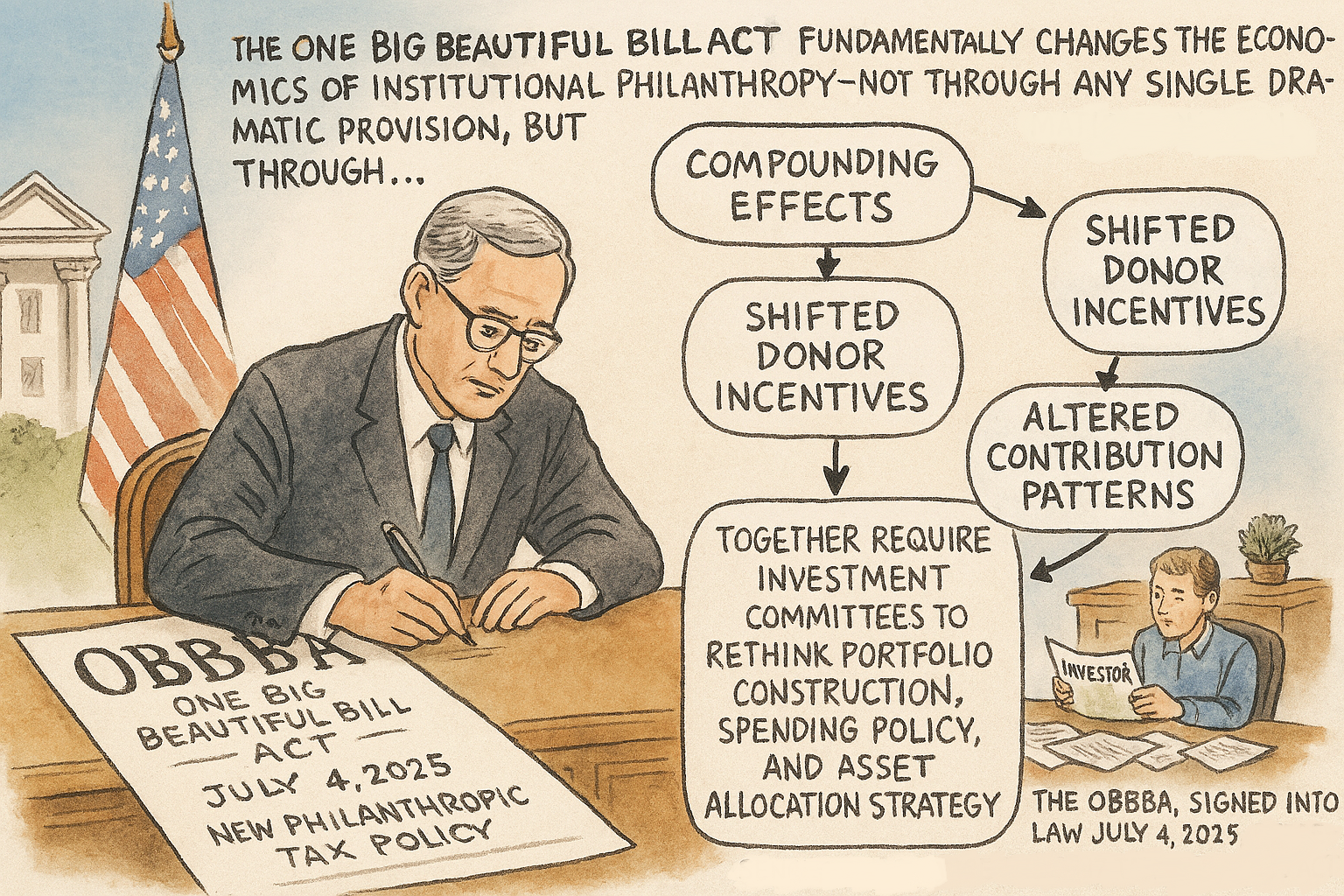
While the final OBBBA significantly impacts philanthropic organizations, board members and investment committees should understand that several more onerous provisions were removed during the legislative process, demonstrating the effectiveness of nonprofit sector advocacy.
Provisions Successfully Eliminated:
1. Section 501(p) "Terrorist-Supporting Organization" Provision
- What it would have done: Granted Treasury Secretary authority to revoke tax-exempt status of organizations deemed to support terrorist groups, with limited due process
- Why it was removed: Over 2,300 nonprofit organizations and advocacy groups opposed the provision, citing due process concerns and potential for politically-motivated targeting
- Current status: Not included in final law, but may resurface in future legislation
2. UBIT Expansion on Name and Logo Royalties
- What it would have done: Treated royalty income from licensing organizational names/logos as unrelated business taxable income
- Impact if passed: Would have significantly reduced net revenue from licensing agreements
- Status: Removed from final bill
3. UBIT on Parking and Transportation Benefits
- What it would have done: Reinstated the controversial "parking tax" requiring nonprofits to pay UBIT on employee parking and transit benefits
- Why it mattered: Urban nonprofits faced significant administrative costs calculating the tax (often exceeding the tax itself)
- Status: Not included; had been retroactively repealed in 2019 after bipartisan opposition
4. More Aggressive Private Foundation Excise Tax Increases
- What was proposed: Tiered excise tax on private foundation investment income reaching 10% at highest levels
- Estimated impact: $2.9 billion in annual additional taxes on largest foundations
- Status: Not included in final legislation
Governance Implications:
The removal of these provisions demonstrates three critical points:
- Advocacy matters: Coordinated nonprofit sector engagement successfully prevented more damaging outcomes
- Vigilance required: Removed provisions may return in future legislation; organizations should maintain robust compliance and due diligence programs
- Relative positioning: While OBBBA creates challenges, the final legislation is substantially more favorable than early drafts suggested
Investment committee action: Document review of governance, compliance, and due diligence procedures in board minutes. Ensure gift acceptance policies, international partnerships, and licensing agreements meet high standards that would withstand heightened scrutiny.
IV. Investment Strategy Implications: Portfolio Construction in the New Environment
A. Liquidity Management and Distribution Planning
The potential 2025 year-end giving surge, anticipated 2026-2027 contribution volatility, and uncertain demand pressures may merit robust scenario planning.
Considerations for Enhanced Liquidity Approach:
- Organizations may wish to consider maintaining 12-18 months of operating expenses in liquid reserves (versus traditional 6-12 months), depending on risk tolerance and specific circumstances
- Potential rebalancing toward predictable income generation:
- Investment-grade corporate and municipal bonds
- Dividend-focused equity strategies
- Private credit or structured income where appropriate and consistent with investment policy
- Consider developing contingency distribution plans with specific triggers for evaluating spending rate adjustments
B. Tax-Efficient Portfolio Construction
For organizations potentially subject to excise taxes on investment income, after-tax return optimization may become increasingly important.
Potential Tax-Advantaged Strategies to Consider:
- Municipal bonds: Tax-exempt income may help avoid excise tax exposure, depending on specific circumstances
- Opportunity Zone investments: May provide favorable tax treatment, subject to eligibility and risk considerations
- Master limited partnerships: Certain structures may offer beneficial treatment, though individual circumstances vary
- Private equity and venture capital: Realized gains typically only upon exit, potentially allowing tax-timing flexibility
Manager Selection Considerations:
Investment committees may wish to evaluate:
- After-tax returns (not just pre-tax performance) for organizations subject to excise taxes
- Tax-loss harvesting capabilities where applicable
- Capital gains realization management approaches
Note: The suitability of any tax-advantaged strategy depends on your organization's specific circumstances, risk tolerance, and investment policy. Consult with qualified investment and tax advisors.
C. Non-Cash Gift Infrastructure and Illiquid Asset Management
With potentially reduced tax benefits for cash donations among high-income donors, appreciated securities and complex assets may become preferred giving vehicles. The combination of the 0.5% AGI floor and 35% deduction cap may make appreciated stock gifts relatively more attractive.
Potential Donor Behavior Changes:
- Cash giving: 2026 deduction at 35%, subject to 0.5% AGI floor
- Appreciated securities: Full FMV deduction at 35%, no AGI floor, plus avoidance of capital gains tax
- Result: Non-cash gifts may become even more tax-efficient for high-income donors relative to cash contributions
Investment Committee Implications:
- Organizations may see an increase in gifts of:
- Publicly traded securities
- Private company stock (requiring valuation and liquidity planning)
- Real estate
- Cryptocurrency and digital assets
- Partnership interests and S-corp stock
- Organizations should consider:
- Gift acceptance policies that address complex asset types and associated risks
- Relationship with investment banking or advisory firms capable of handling illiquid asset valuation and liquidation
- Legal counsel versed in non-cash gift structures and UBIT considerations
- Infrastructure for rapid decision-making when time-sensitive complex gifts arise
🎯 Strategic Advantage: Investment Banking Capability
Organizations with access to investment banking expertise may have a competitive advantage in this environment:
- Ability to accept and efficiently liquidate complex gifts
- Relationships for valuation and transaction execution
- Understanding of deal structures, earnouts, and escrow arrangements
- Network for placing illiquid positions
This could differentiate donor experience and potentially increase major gift acceptance rates.
D. Key Portfolio Priorities for 2026
Suggested Actions Investment Committees May Wish to Consider:
- Update investment policy statements to potentially address:
- Excise tax considerations in return calculations where applicable
- Enhanced liquidity requirements given potential demand uncertainty
- Authorization for complex gift acceptance and rapid deployment
- Conduct 2026-2028 contribution scenario modeling incorporating:
- Q4 2025 acceleration surge (estimate range)
- 2026 post-legislation adjustment (model various scenarios)
- Long-term equilibrium under new incentive structure
- Review spending policies for potential mission-critical flexibility:
- Conditions under which temporary deviations might be considered
- Board authorization frameworks for rapid response
- Multi-year smoothing mechanisms to handle volatility
- Evaluate development team readiness for complex gifts:
- Gift acceptance policy updates
- Relationships with valuation and legal experts
- Marketing materials highlighting ability to accept non-cash gifts
- Assess potential excise tax exposure across all highly compensated employees
- Review UPMIFA documentation and compliance procedures to ensure OBBBA factors may be considered
These are general considerations and may not apply to all organizations. Consult with qualified advisors regarding your specific circumstances.
V. The Together Forward Capital Advantage: Integrated Advisory for Institutional Investors
Most investment advisors can help you understand the OBBBA's provisions. Together Forward Capital aims to help you understand how those provisions may fundamentally reshape your capital structure, distribution strategy, and mission sustainability.
Our Distinctive Three-Part Platform
1. Traditional Investment Advisory Services
- Comprehensive asset allocation and manager selection
- Performance monitoring and rebalancing
- Cash flow modeling and spending policy optimization
- UPMIFA compliance support and investment policy statement development
2. Investment Banking Capabilities
- Structuring and valuation of complex non-cash gifts
- Access to pre-IPO companies and late-stage private market opportunities
- Dealflow from entrepreneurs, family offices, and institutional partners
- Secondary market transactions for illiquid assets
3. Specialized Philanthropic Sector Expertise
- Deep understanding of foundation and endowment governance
- Knowledge of nonprofit accounting, tax-exemption, and regulatory requirements
- Network for peer benchmarking and best practice sharing
This integration of advisory, banking, and philanthropic insight creates a continuum of service that may be unavailable in traditional investment advisory models.
A foundation receives a $5 million gift of pre-IPO company stock.
- Investment Banking: Provide valuation analysis and assist with efficient liquidation
- Investment Advisory: Consider strategic deployment of proceeds within overall portfolio context
- Philanthropic Expertise: Help ensure compliance with gift acceptance policies and UPMIFA requirements
This integrated approach may be unavailable from traditional RIAs or standalone investment banks.
VI. The 2025 Year-End Planning Imperative
The window for donors to potentially capture the full 37% deduction on major gifts closes December 31, 2025.
Potential Action Items to Consider
For Board and Development Teams:
- Consider educating major donors about the potential benefits of accelerating significant 2025 contributions
- Review gift acceptance infrastructure to ensure readiness to handle potential Q4 2025 complex gifts
- Develop communications highlighting the January 1, 2026 deadline and its potential implications
Note: Fundraising communications should be reviewed by legal counsel to ensure compliance with solicitation regulations.
For Investment Committees:
- Consider updating investment policy statements to address excise tax considerations where applicable
- Model balance sheet scenarios: potential 2025 surge and possible 2026-27 adjustment patterns
- Review UPMIFA compliance procedures to consider incorporating OBBBA factors
- Assess liquidity positioning for potential deployment of large gifts
- Calculate potential exposure to executive compensation excise tax
For Finance Teams:
- Update budget projections incorporating potential contribution pattern changes
- Model potential impact of excise tax costs on net returns (where applicable)
- Review spending policy sustainability under multiple scenarios
📅 Timeline of Key Effective Dates
Q4 2025 (NOW through December 31)
- Last opportunity for donors to capture 37% deduction (versus 35% in 2026)
- High urgency for major gift solicitation
January 1, 2026
- Universal charitable deduction takes effect ($1K/$2K)
- 0.5% AGI floor for itemizers begins
- 35% deduction cap for top bracket begins
- 1% corporate giving floor begins
- Executive compensation excise tax expansion takes effect
- Tiered endowment tax takes effect
- $15M/$30M estate exemption takes effect
January 1, 2027
- $1,700 scholarship tax credit becomes available
- First inflation adjustments to estate exemption
Ongoing
- Federal program adjustments phase in over multiple years; committees should revisit liquidity and spending assumptions annually
VII. Conclusion: From Compliance to Strategy
The OBBBA represents a potentially significant restructuring of how philanthropy operates in America. Donor incentives may have shifted. Institutional costs may have increased for many organizations. Service demands are projected to potentially rise significantly. Estate planning motivations may have changed.
For investment committees and foundation boards managing $10 million or more in assets, this moment may merit sophisticated financial analysis, not just fundraising recalibration. The organizations that may be best positioned to thrive are those that view OBBBA as a strategic planning opportunity: to potentially optimize portfolio construction for after-tax returns, to build infrastructure for complex gift acceptance, to model multiple future scenarios, and to consider whether their investment approach aligns with a potentially transformed operating environment.
Together Forward Capital exists at the intersection of investment advisory, investment banking, and philanthropic sector expertise. Our exclusive focus on foundations, endowments, and nonprofit organizations means we understand both the regulatory nuances and the mission-critical imperatives that drive institutional decision-making.
The OBBBA's full impacts may unfold over years, but the strategic decisions you consider in the coming months could influence your organization's capacity to serve your mission for decades.
The views expressed in this article represent our assessment of the One Big Beautiful Bill Act based on current information and understanding of the legislation. Tax laws are subject to interpretation and their application depends on specific circumstances. This article should not be used as the sole basis for financial or legal decisions. We encourage all organizations to consult with qualified tax, legal, and investment advisors regarding their specific situations.
About Together Forward Capital
Together Forward Capital is an SEC-registered investment advisory firm operating as a DBA of R.F. Lafferty & Co., Inc., exclusively serving philanthropic organizations including foundations, endowments, and nonprofits. Our unique dual-capacity platform combines traditional investment advisory services with investment banking capabilities, providing clients with sophisticated portfolio management and exclusive access to private market opportunities.
Schedule a Complimentary Portfolio Review